In today's competitive manufacturing landscape, technology has become a strategic tool that manufacturing companies use to improve competitiveness and operational efficiency. One of the most valuable is EDI technology, short for Electronic Data Interchange. The role of EDI in manufacturing is huge: it connects a manufacturer with every trading partner across the supply chain, from raw-material suppliers to distributors and retailers.
This blog post explains what EDI is, how EDI works, the common EDI transactions used in manufacturing, the benefits of EDI, and how to choose the right EDI solution. Learn how EDI in manufacturing helps companies build stronger partner connections and deliver more value.
What Is Electronic Data Interchange (EDI) in Manufacturing?
EDI can be defined as “the computer-to-computer exchange of business documents in a standard electronic format between business partners.” It is strategically important, because good information systems play a cardinal role in helping manufacturers survive in a digitally competitive era.
EDI in manufacturing replaces paper, email and fax with structured EDI documents that systems can read without human intervention. Instead of re-keying a purchase order from a PDF, the manufacturer's system receives it as an EDI file and posts it automatically. This removes the need for manual data entry, which is one of the biggest sources of delays and errors in manufacturing processes.
To make this exchange possible, every EDI transaction follows agreed EDI standards. The most common EDI standards are:
- ANSI X12, used mainly in North America, where each document type is a numbered transaction set (for example, EDI 850 for a purchase order).
- UN/EDIFACT, the international standard used widely in Europe and Asia.
- Industry-specific standards, such as ODETTE and AIAG guidelines in the automotive sector, which build on these common EDI standards.
What's more, EDI plays a pivotal role in transforming operational processes and streamlining communication between stakeholders. EDI in manufacturing facilitates the seamless exchange of critical business documents, such as purchase orders, invoices and shipping notices, between suppliers, manufacturers and distributors. By standardizing data formats and automating the exchange of information, EDI enhances supply chain efficiency, accelerates order processing, improves inventory management and fosters closer collaboration within the manufacturing ecosystem.
By introducing EDI into their operations, manufacturers can tighten supply chain operations and reduce overhead costs. They can use an integrated EDI approach to share information across departments, such as sales (tracking a purchase order), accounts and finance (sending payment notifications), and inventory control (executing product planning). Manufacturers also rely on EDI systems to minimize supply chain management problems such as stockouts, low inventory and stock loss.
How EDI Works: The 6-Step EDI Process
For a long time, EDI integration software has been used by manufacturers to streamline business-to-business (B2B) transactions, enhance value creation and save time to gain a competitive edge. Behind every exchange, EDI software follows six simple steps:
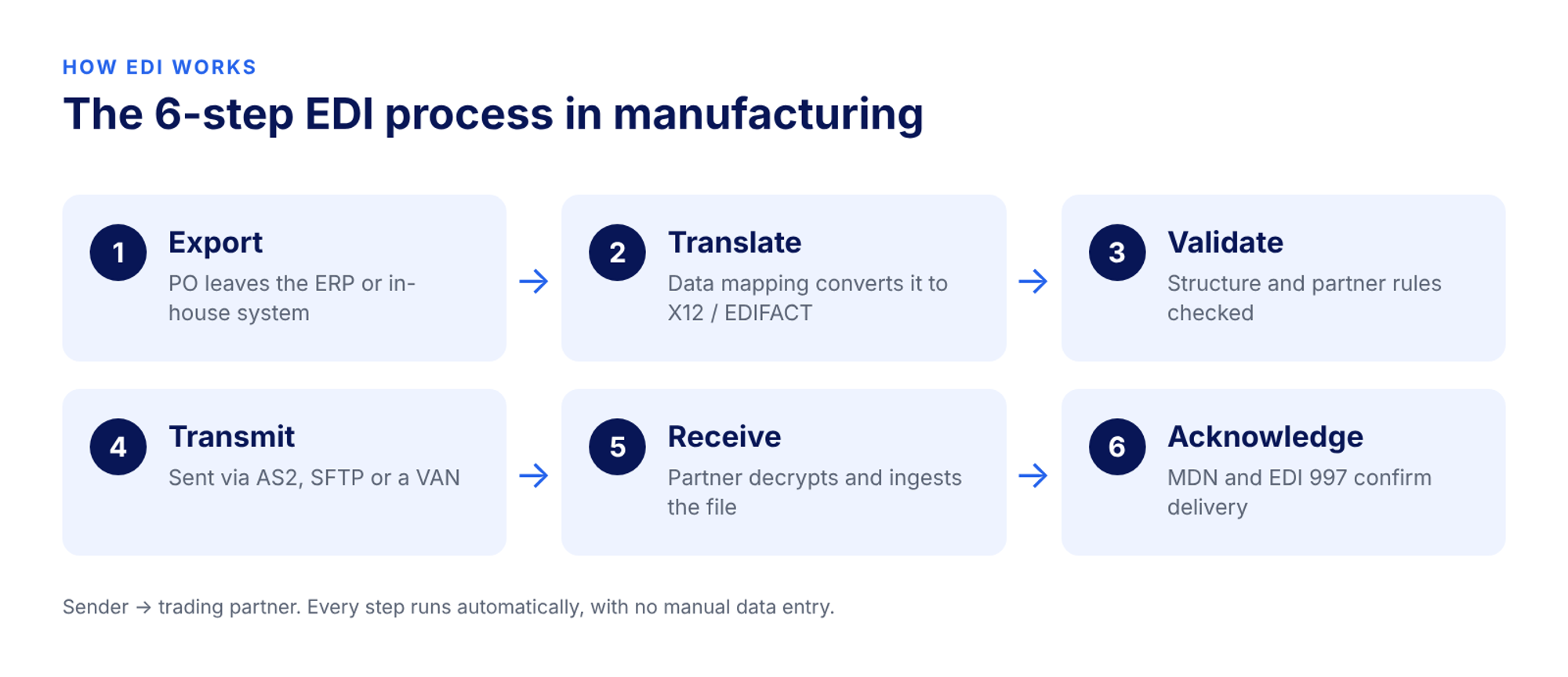
- 1.Export. A sender exports a document, a purchase order in this case, from an in-house application or ERP system.
- 2.Translate. The purchase order is converted into an acceptable EDI format with a data mapping solution or another EDI translator.
- 3.Validate. The EDI document is run through validation software to ensure structural accuracy and EDI compliance with the partner's requirements.
- 4.Transmit. EDI files are sent to a value-added network (VAN), or straight to the trading partner over a direct connection, using secure EDI communication protocols such as AS2 or SFTP.
- 5.Receive. The receiver verifies, authenticates and decrypts the file, then ingests the EDI document into its own systems.
- 6.Acknowledge. A message disposition notification (MDN) and, in many EDI environments, a functional acknowledgment (EDI 997) are sent back to confirm delivery.
Because each step is automated, EDI workflows move data from one business process to the next without anyone re-typing it. This is how EDI work stays fast, consistent and traceable across the supply chain.
See EDI automation in action
Watch how Adeptia Connect automates EDI translation, mapping and partner exchange.
Common EDI Documents and Transactions in Manufacturing
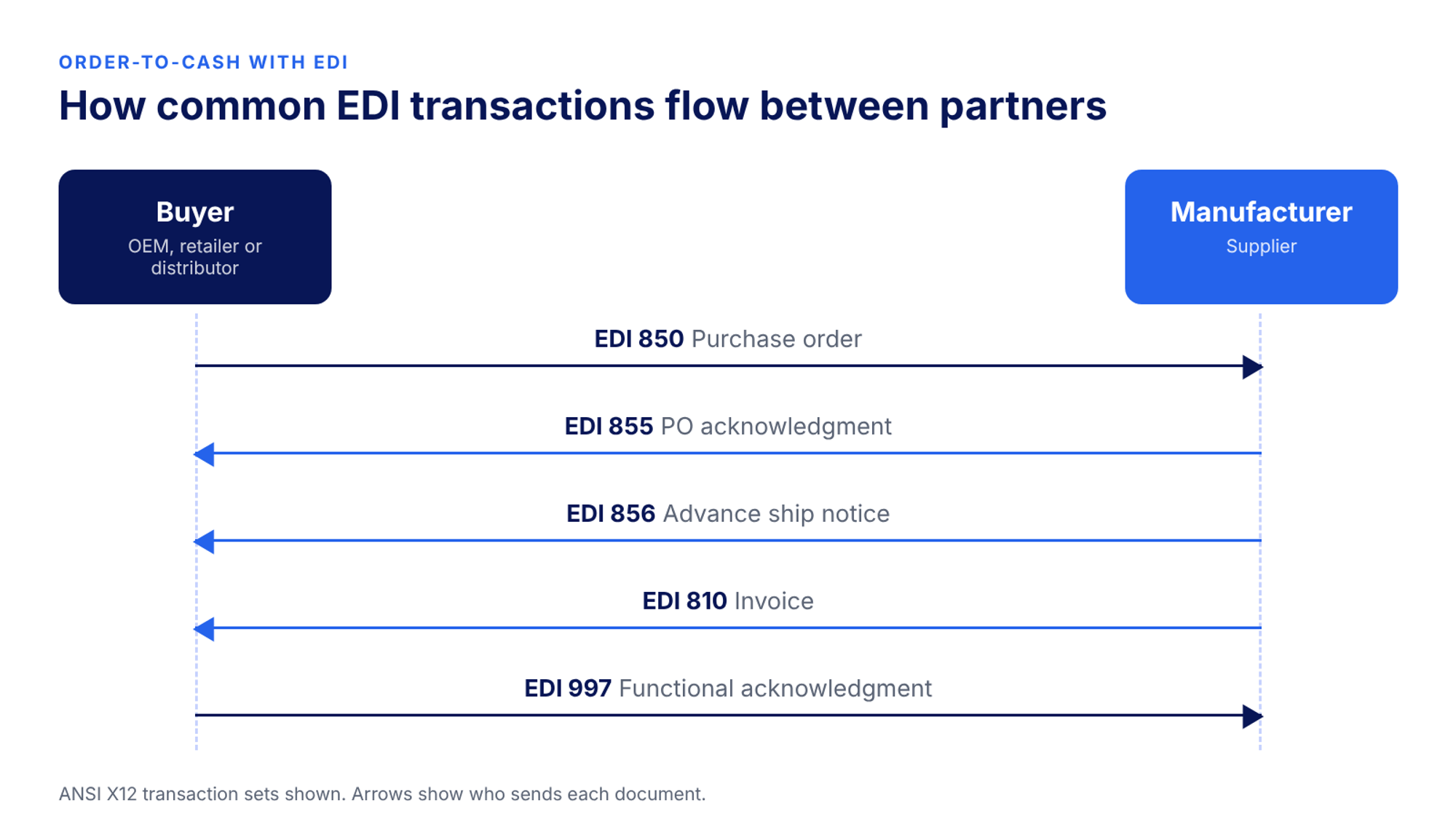
EDI transactions in the manufacturing industry cover the full order-to-cash cycle. Common EDI documents include purchase orders, acknowledgments, shipping notices and invoices. Each maps to one of the standard EDI transaction sets, so every trading partner reads it the same way. These are the common EDI transactions manufacturers exchange most often (ANSI X12 numbers shown):
| EDI transaction set | Document | How it is used in manufacturing |
|---|---|---|
| EDI 850 | Purchase order | A buyer orders parts, materials or finished goods |
| EDI 855 | Purchase order acknowledgment | The supplier confirms, changes or rejects the order |
| EDI 830 | Planning schedule | The customer shares forecasts so suppliers can plan production |
| EDI 862 | Shipping schedule | The customer sets short-term, just-in-time delivery requirements |
| EDI 856 | Advance ship notice (ASN) | The supplier details what is shipping, how it is packed and when it will arrive |
| EDI 846 | Inventory inquiry/advice | Partners share stock levels to prevent stockouts |
| EDI 810 | Invoice | The supplier bills for goods shipped |
| EDI 897 | Functional acknowledgment | Confirms an EDI transaction was received and is structurally valid |
EDI transactions often travel in a chain: an EDI 850 triggers an 855, then an 856 and finally an 810. When these key EDI documents flow automatically, the data flow between partners stays accurate from the first order to the final payment.
Benefits of EDI in Manufacturing
EDI transactions in the manufacturing industry drive operational efficiency, supply chain visibility, partner collaboration and customer satisfaction. EDI tools deliver automated workflows, more visibility into supply chain operations and a better customer experience. Here is how EDI helps manufacturers in practice. Using the common EDI steps above, manufacturers can:
- Build efficient partner processes. EDI enables more efficient processes with OEMs, suppliers, customers and partners, establishing seamless communication and better experiences.
- Get real-time visibility. Real-time data exchange gives end-to-end visibility over data streams for better decision-making, so enterprises can manage manufacturing and inventory processes as demand rises and falls.
- Speed up operations. Manufacturers can prepare shipping documents, send advance ship notices (ASNs) and create purchase orders instantly. Time saved by eliminating manual data entry can go to value-added work like continuous improvement.
- Improve logistics coordination. EDI improves cooperation between logistics functions, helping organizations stay ahead of the competition without hurting the bottom line.
- Cut costs and chargebacks. Faster transactions and fewer errors reduce overhead costs and potential chargeback situations.
- Meet JIT and SLA commitments. On-time delivery helps manufacturers follow just-in-time (JIT) principles and meet SLAs, and EDI supports omnichannel operations no matter where the order is raised.
- Strengthen partner relationships. Better response times with all business partners improve sales and speed to revenue.
In short, EDI offers a single, standard way to exchange data across the manufacturing value chain. Running operations with EDI also provides a reliable record of every order, shipment and invoice. Advantages of EDI compound over time: every new trading partner connected through the same EDI system adds value without adding manual work.
Adeptia Automate for Manufacturing and Distribution
See how manufacturers automate order capture, inventory visibility and supplier onboarding.
Integrating EDI with ERP and Manufacturing Systems
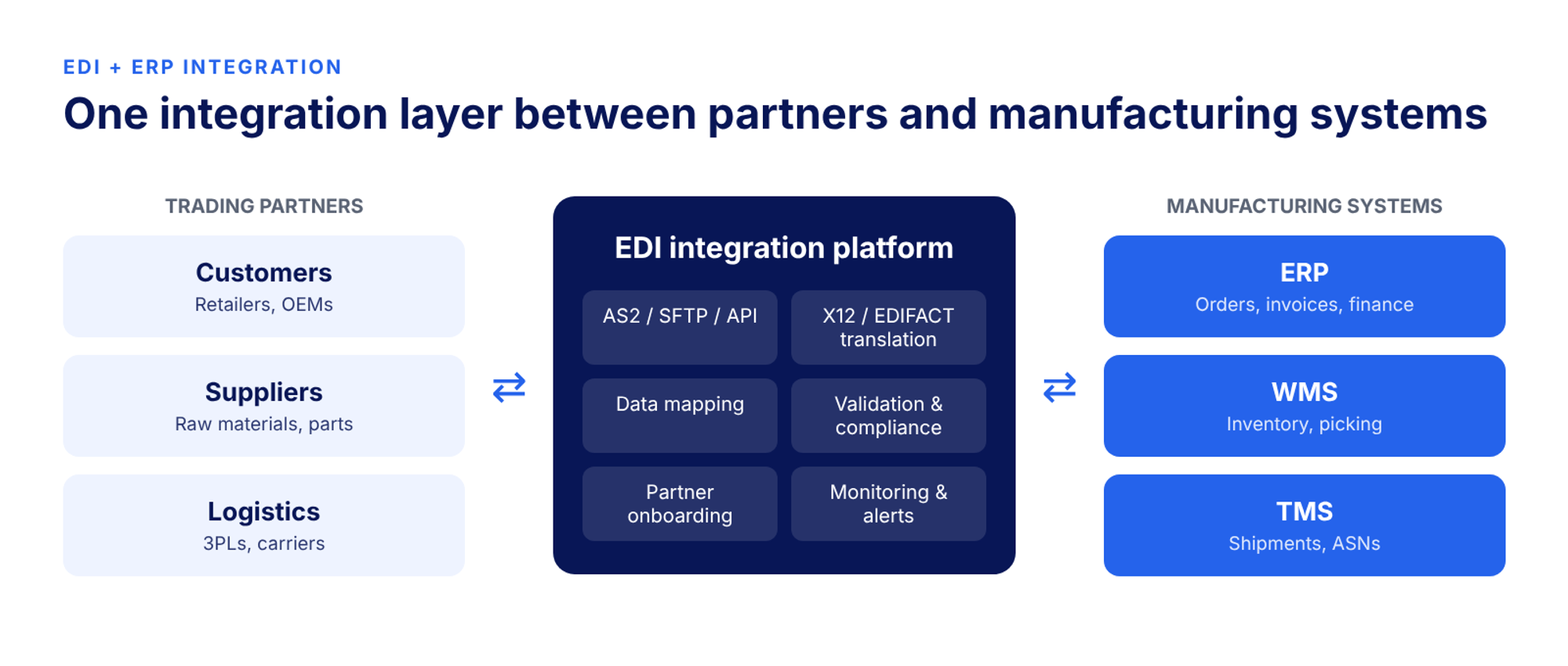
EDI delivers the most value when it is connected to the systems that run the business. Integrating EDI with ERP means an incoming EDI 850 becomes a sales order in the ERP automatically, and an EDI 810 invoice is generated from the ERP's billing data without re-keying.
When EDI integration connects ERP, warehouse management and transportation systems, data moves across the manufacturing operation in one continuous flow. Teams no longer reconcile spreadsheets between systems, and every department works from the same order, inventory and shipment data. Manufacturers that integrate EDI with ERP also gain an audit trail for every EDI exchange, which simplifies EDI compliance with partner requirements.
Cloud-Based EDI vs. Legacy EDI Tools
Many manufacturers still run legacy EDI tools on-premises: point-to-point scripts, separate translators and hard-coded maps that only a few specialists understand. Onboarding a new trading partner on these platforms can take weeks.
Cloud-based EDI solutions take a different approach. A modern EDI solution offers:
- Faster partner onboarding through reusable maps and templates.
- Real-time EDI processing instead of overnight batches.
- Secure EDI over AS2, SFTP and APIs, with encryption and monitoring built in.
- Scalability to handle seasonal peaks and new channels without new hardware.
Cloud EDI platforms also make it easier to combine EDI with APIs, so manufacturers can serve partners that use either method. An EDI cloud service also removes the need to maintain EDI servers in-house.
Challenges of EDI in Manufacturing (and How to Overcome Them)
The challenges of EDI usually come from complexity, not the technology itself:
- Different partner requirements. Each partner may use its own version of a standard. A mapping-led EDI platform with reusable templates reduces this effort.
- Integration gaps. EDI that stops at the translator still leaves manual steps. End-to-end integration of EDI with ERP closes the gap.
- Limited visibility. Failed or late EDI transactions often go unnoticed until a chargeback arrives. Dashboards and alerts catch errors early.
- Skills bottlenecks. Legacy EDI depends on a few experts. Self-service tools let business users onboard partners and manage EDI processes.
Improve Productivity With Reimagined B2B Data Integration
Learn how a self-service, automation-driven approach removes B2B integration bottlenecks for IT and business teams.
The Future of EDI in Manufacturing
The future of EDI in manufacturing is cloud-first, API-friendly and increasingly automated. Manufacturers are using AI-assisted mapping to automate EDI onboarding, combining EDI with APIs for real-time updates, and feeding EDI data into analytics for better forecasting. EDI is not being replaced; it remains essential for manufacturing because retailers, OEMs and distributors still require it. What is changing is how easily manufacturers can manage it.
Adeptia Automate Live Demo
Watch the demo webinar to see how AI-powered automation handles enterprise and partner data.
Choosing the Right EDI Solution for Your Manufacturing Business
When implementing an EDI program, or replacing older EDI manufacturing software, look for EDI integration for manufacturers that covers the full process, including EDI translation, mapping and partner management. The right EDI solution:
- Supports common EDI standards (ANSI X12 and EDIFACT) and the transaction sets your partners require.
- Integrates EDI with your ERP and other manufacturing systems, not just the translator.
- Speeds up trading partner onboarding with reusable maps and self-service tools.
- Provides secure EDI communication and full visibility into every EDI transaction.
- Scales as a cloud-based EDI solution, without depending only on EDI service providers for every change.
The right EDI implementation turns EDI from a compliance cost into a competitive advantage. For practical tips, read our B2B EDI integration best practices.
Frequently Asked Questions About EDI in Manufacturing
Keep Your Manufacturing Business Ahead of the Game with EDI
With the ability to re-engineer information flows and business processes, EDI integration helps manufacturers create digital moments at scale by boosting productivity, revenue, market reputation and growth. Modern EDI solutions can simplify partner connections, and the right EDI solutions ensure seamless EDI exchange with every partner. Whether you need EDI for manufacturing, distribution or retail partners, a standard like EDI can help transform your manufacturing operations.
If the benefits are so many, isn't it high time to implement EDI in your manufacturing business?
Ready to modernize EDI in your manufacturing business?
See how Adeptia connects your trading partners, ERP and supply chain systems.