Effective dates, election deadlines, and go-live dates are fixed on the open enrollment calendar. No matter how large or complex a group is, every carrier, broker, TPA, and benefits administrator is working against that same clock.
The data behind enrollment doesn't operate on the same schedule. Census files and elections arrive from dozens of employers and HRIS platforms, each in its own format: a clean CSV here, an inconsistent Excel file there, a broker's PDF nobody's rebuilt in years. Somebody has to reconcile it by hand before a single record can move. That mismatch, a fixed deadline meeting a variable, manual process, is why enrollment timelines still break.
The Enrollment Data Timeline Today
Enrollment data doesn't travel in a straight line. An employer finalizes elections and hands census data to a broker or benefits administration platform, which gets it to the carrier, often through a TPA along the way for COBRA, FSA, or HSA handling. At each hop, the data may need to shift formats, or arrive in a shape the receiving system wasn't built to read.
A benefits administrator receiving data from 500 employer groups is effectively receiving 500 slightly different versions of the same information, and reconciling those differences has typically meant manual cleaning before a file is usable. Errors that surface partway through force a round trip back to the source. Multiply that across every employer group and every enrollment cycle, and the weeks add up, not because any single step is slow, but because so many still require human intervention before data can move on.
The Structural Causes Behind Every Delay
None of this happens because carriers or benefits administrators are moving slowly on purpose. Every team involved is working under real pressure to hit a fixed date, and most have already modernized the systems on either end of the exchange. The delay lives in the handoff itself, and it comes down to four causes:
- File variations – Employers, brokers, and TPAs each export in whatever format their own systems produce, so every new variation means someone has to manually figure out how it maps.
- Unique partner needs – Without a common data model, connecting a new broker or employer typically means a custom integration from scratch, none of it reusable for the next partner.
- Compressed testing – Testing rounds are supposed to catch errors early, but they're usually the first thing cut when other steps run long, pushing errors downstream where they're far more expensive to fix.
- Fixed deadlines – Every upstream delay gets absorbed by whatever time is left before go-live, usually by cutting corners on the step meant to catch mistakes in the first place.
The Cost of Slow Enrollment Data
Delayed or inaccurate enrollment data moves outward, and every stakeholder absorbs a different version of the same problem.
- Carriers face slow revenue recognition, since a group that takes weeks to onboard isn't generating premium during that gap.
- Employers experience onboarding friction as a service failure. If timelines slip close to open enrollment, their employees feel the consequences, eroding trust at a critical moment.
- Members feel the real-world impact since a missing or mismapped record can mean showing up to a pharmacy with no coverage on file despite enrolling correctly. Dependents are especially vulnerable, since incomplete census data often drops spouse or child records quietly.
None of these costs show up as a single line item, which is exactly why they've been tolerated for so long. Add them together, and the cost of a slow first mile is far higher than it looks.
What’s Changed About LIMRA's LDEx Standards
LIMRA introduced the LDEx (LIMRA Data Exchange) standards in January 2020 to standardize how carriers and benefits administration platforms exchange data, establishing common terminology and structure so systems on either end agree on what a field means without every relationship reinventing that agreement.
The standards have expanded well beyond that first release. Four are available today, with more in development:
- Benefits Enrollment Management (BEM) – coverage elections, changes, and terminations across medical, dental, vision, pharmacy, disability, life, and more, with real-time processing over REST APIs.
- Evidence of Insurability Status & Decision (EOIS) – lets carriers pass underwriting decisions back to the administrator.
- Benefits Configuration Management – standardizes how carriers share plan design details with technology providers.
- Quote Standard (in development) – will standardize pre-sale and renewal request data.
LDEx defines the format and content of data being exchanged, not how that data gets transferred, and it says nothing about the messy inputs arriving from employers and brokers before that data is ever LDEx-ready. That translation work is the piece LDEx was never designed to handle.
More than 60 carriers, benefits administration platforms, and technology providers, including Cigna, MetLife, Prudential, UnitedHealthcare, Voya, Workday, and ADP, have adopted LDEx. But while carriers and larger platforms have moved fastest, smaller brokers and TPAs, often the source of the messiest files, have been slower to adapt, leaving most organizations in a mixed environment.
What a Modern Enrollment Timeline Looks Like
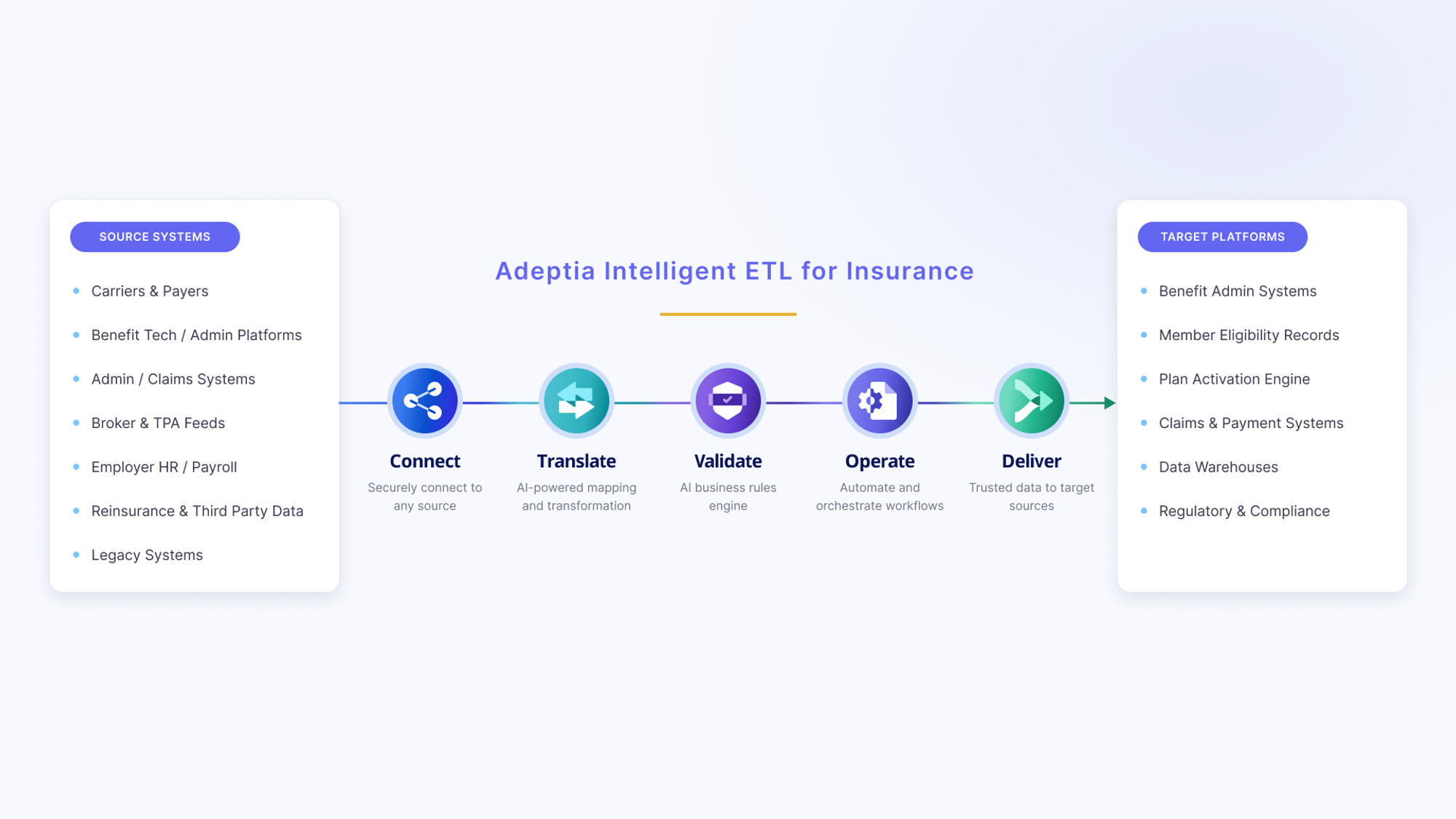
LDEx gives the industry a shared destination, but getting there doesn't require waiting for every partner to adopt it. A faster, cleaner enrollment process comes down to what happens at each stage of the pipeline, regardless of where any given partner stands on standardization.
- 1.Intake: Data arrives in whatever form the sender uses – CSV, Excel, JSON, PDF, or plain text, over API or SFTP – without asking employers or brokers to change their own systems first.
- 2.Translation: Incoming data maps to a common model automatically, whether the target is LDEx or an internal standard.
- 3.Validation: Global, plan-specific, and destination-specific rules run at intake, catching errors before data ever reaches production.
- 4.Oversight:. Business teams get real-time visibility and control, so onboarding a new employer or broker doesn't require pulling in IT every time.
- 5.Scale: The process holds at volume, so the hundredth new partner connects as easily as the first.
What Carriers and Ben-Admin Platforms Should Do Next
LDEx is worth adopting, and worth pushing partners toward, since a shared standard makes every future integration easier. But waiting on full ecosystem adoption before fixing the timeline problem gets the priorities backward. The employers, brokers, and TPAs sending fragmented data today aren't going to standardize on your schedule, and the first-mile translation work has to happen regardless. The real starting point is fixing how you ingest, validate, and standardize incoming data, then letting LDEx compound on top.
See what faster enrollment onboarding looks like. Schedule a demo to see how Adeptia Automate turns weeks of manual enrollment work into a process measured in hours.