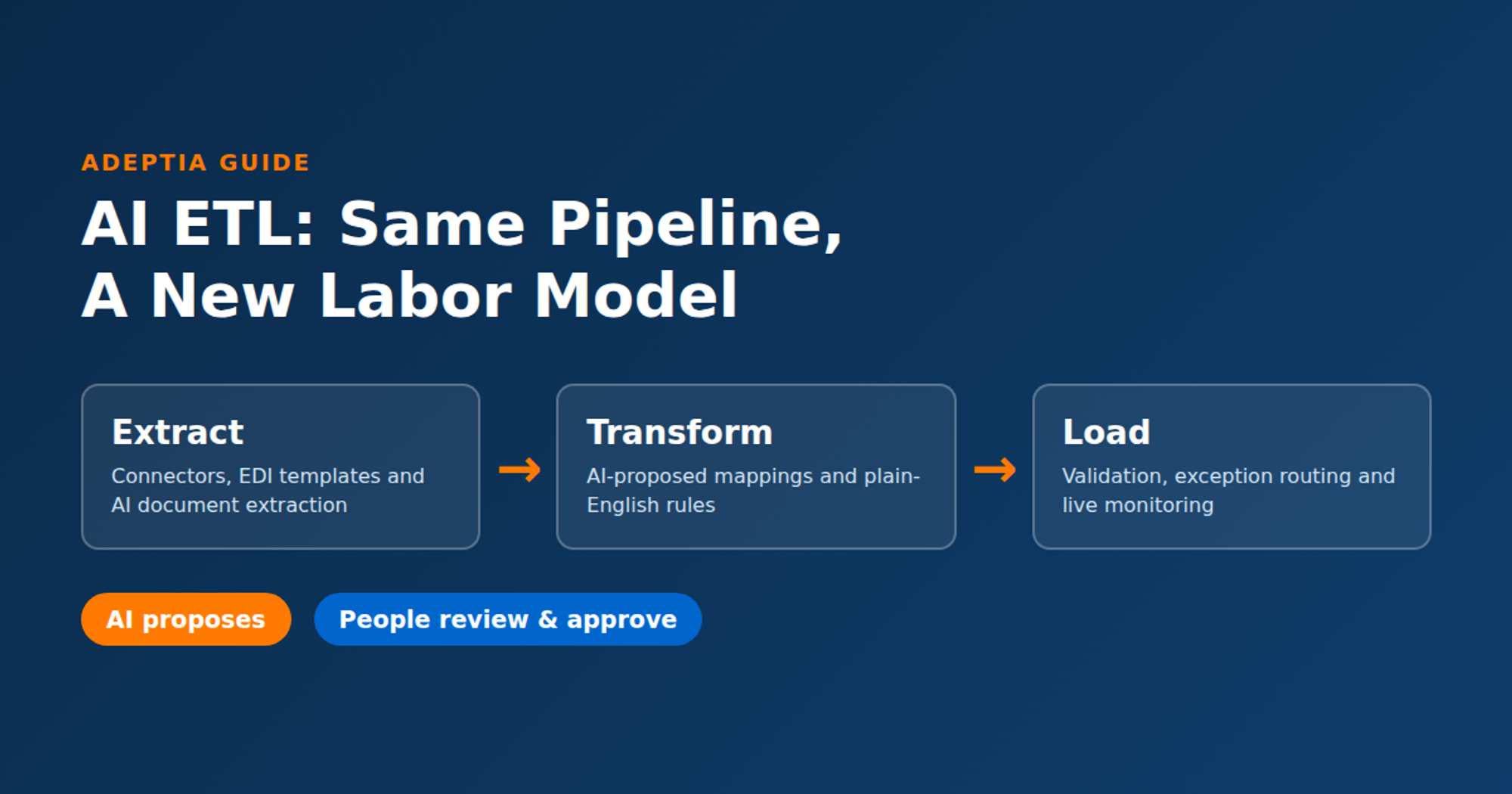
For decades, the ETL data pipeline has followed the same basic shape: pull data out of a source system, transform the data into a new structure, and load the data into a destination. What's changing under AI ETL isn't the shape of the modern ETL data pipeline; it's who, or what, does the work inside it. A modern AI ETL platform uses artificial intelligence and machine learning to handle the labor-intensive parts of extract, transform, and load: data mapping, validation rule authoring, document data extraction, and exception handling. Engineers used to write every data mapping and every rule by hand. With AI ETL, AI proposes the data mapping work and humans review and approve it.
This guide covers what AI ETL actually means, how it differs from traditional ETL and ELT, why traditional ETL pipelines break down in real enterprise data environments, how AI ETL works across extract, transform, and load, what agentic ETL adds on top, the governance questions AI ETL raises, and what to look for when evaluating AI ETL tools and platforms.
What Is AI ETL? Understanding AI-Powered Data Integration
AI ETL is extract-transform-load data integration where artificial intelligence, specifically machine learning and generative AI, performs the data mapping, rule-writing, and data-quality work that engineers have traditionally done by hand. The data pipeline still does the same three jobs: extract data from a source, transform the data into the shape a target system expects, and load the data where it needs to go. What changes is the labor model. In an AI ETL pipeline, an AI engine proposes schema mappings for the data, drafts validation rules from plain-language descriptions, extracts structured data out of unstructured documents, and flags data exceptions for review, and a human confirms the output rather than writing it from scratch.
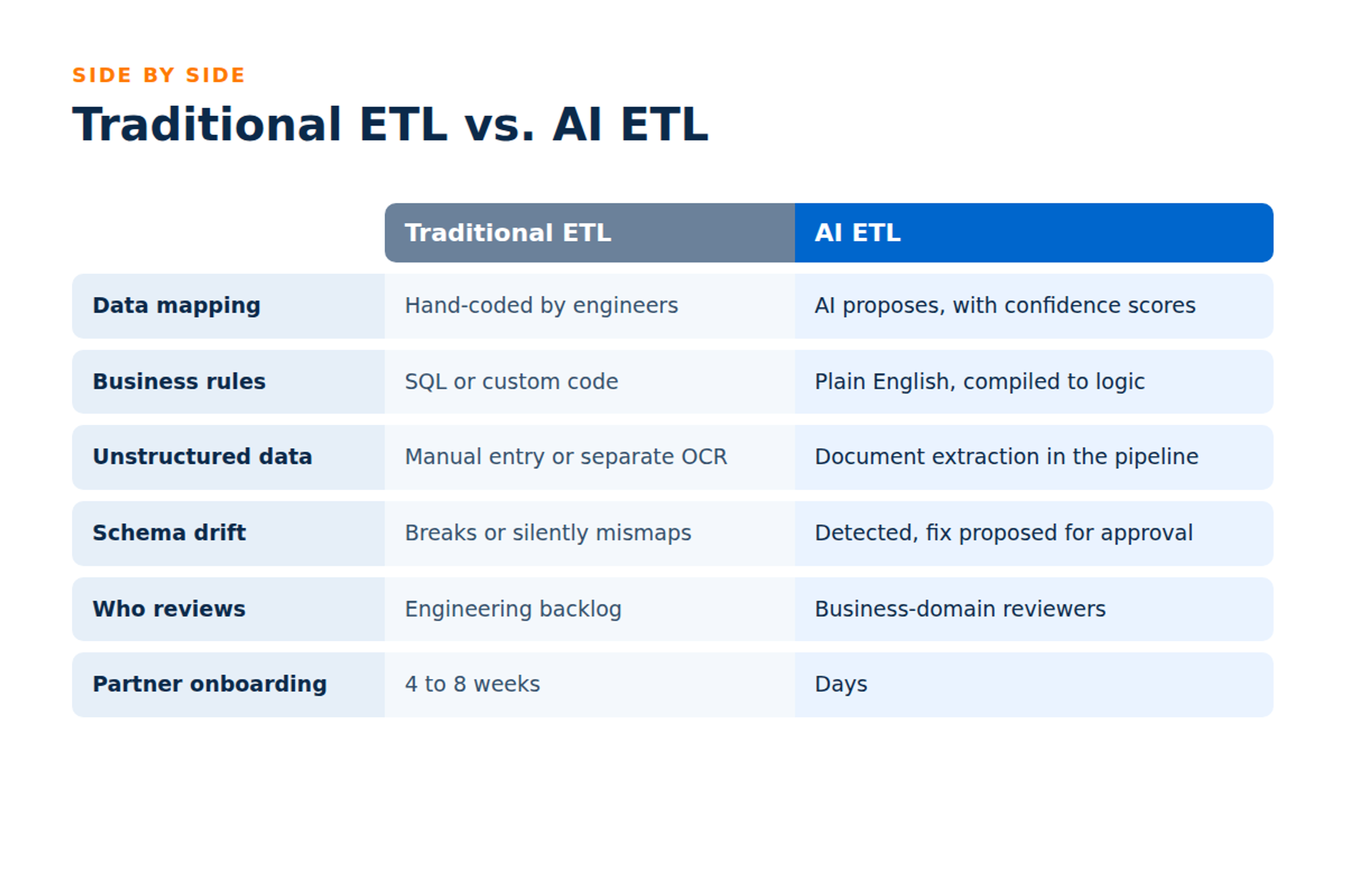
The practical effect shows up in how long integration work takes. Onboarding a new data source or trading partner under a traditional ETL process commonly takes four to eight weeks of engineering time, most of it spent on data mapping and validation logic. Under an AI ETL pipeline, that same data onboarding routinely compresses to days, because the AI does the first pass on the data and a business user reviews it instead of an engineer building it from zero.
AI ETL vs. Traditional ETL: Modern ETL and Data Pipelines
Traditional ETL is engineer-driven at every step. A developer reads the source and target data schemas, writes data mapping rules by hand (often in SQL, XSLT, or a proprietary mapping language), codes the validation logic that catches bad data, and tests the data pipeline before it goes live. Every new data source, every schema change, and every new trading partner kicks off another round of the same manual work.
AI ETL automates that mapping and rule-writing work using AI. A pattern-based machine learning engine proposes schema mappings by matching new source and target schemas against a library of previously validated mappings, and a generative AI engine reasons over field names, sample data, and business context for anything the pattern engine hasn't seen before. Each proposed mapping gets a confidence score, so the pipeline can auto-apply the matches it's certain about and route anything uncertain to a human reviewer. The pipeline architecture doesn't change; data still moves through extract, transform, and load stages, but the work of building and maintaining each stage shifts from engineers writing code to AI proposing logic and business users approving it.
That shift changes who the bottleneck is. In traditional ETL, integration work waits on engineering capacity. In AI ETL, the bottleneck moves to business-domain review, often a better place for it, since the person who understands what a field actually means is rarely the person who wrote the pipeline.
AI ETL vs. ELT
ELT (extract, load, transform) reorders the data pipeline: raw data gets extracted and loaded into a data warehouse first, and data transformation happens afterward, inside the warehouse, using the warehouse's own compute. ELT became popular because modern cloud data warehouses and data lakes can transform data cheaply and quickly at scale, so there's less reason to transform the data before it lands.
AI ETL and ELT aren't opposites; they describe different axes. ELT is about when transformation happens relative to loading; AI ETL is about who or what performs the mapping, rule-writing, and extraction work regardless of pipeline order. A pipeline can be AI-assisted ELT just as easily as AI-assisted ETL: AI can propose the transformation logic that runs inside the warehouse after load, the same way it proposes logic that runs before load in a traditional ETL pipeline. The distinction that matters more for most data teams isn't ETL versus ELT, but whether the mapping and rule work in either pattern is done by hand or proposed by AI and reviewed by a human.
WHITE PAPER
Intelligent ETL: Beyond Data Movement
Learn how AI-powered platforms automate the mapping, validation and onboarding work that traditional ETL tools leave to engineers.
Why Traditional ETL Breaks in Enterprise Environments
Traditional ETL pipelines were built for a world of stable schemas, structured data, and overnight batch windows. Enterprise data environments today rarely look like that, and the mismatch is where traditional ETL pipelines start to fail.
Static Mappings and Schema Drift
A traditional ETL data mapping is written once, against a schema as it exists on a specific day. When a source system adds a data field, renames one, or changes a data type (schema drift), the static mapping doesn't know. The data pipeline either breaks outright or, worse, keeps running and silently drops or mismaps data until someone notices in a downstream data report. Because traditional mappings are hand-coded, fixing drift requires an engineer to diagnose the change, update the mapping, and redeploy, a cycle that can take days for something a trading partner changed in an afternoon.
Unstructured and Semi-Structured Data
Traditional ETL pipelines are built to extract from structured sources: databases, flat files, well-formed APIs. But a large share of enterprise data doesn't arrive that way. PDFs, scanned documents, faxes, and free-text fields sit outside the pipeline entirely in a traditional ETL setup, requiring manual entry or a separate OCR tool before the extracted data can be joined back in by hand. Every document-based process (a claims form, an invoice, a purchase order attachment) becomes a manual detour around the pipeline rather than a data source the pipeline can extract from directly.
Batch-Only Latency
Traditional ETL pipelines are typically built around scheduled batch runs (nightly, hourly, or some fixed interval) because the mapping and transformation logic is expensive to build and the pipeline is designed to run in bulk. That's a poor fit for operational use cases that need current data: a partner status check, a fraud signal, an inventory update that needs to reflect within minutes, not tomorrow's batch window. Rebuilding a batch pipeline for lower latency usually means rewriting significant parts of the transform logic, not just changing a schedule.
Developer Dependency and Maintenance Cost
Every part of traditional ETL (connecting to a new source, writing a mapping, authoring a validation rule, fixing a broken pipeline) routes through engineering. Business users who understand what the data means can't act on that knowledge directly; they describe requirements to a developer and wait. As the number of sources, partners, and pipelines grows, this dependency doesn't scale linearly; it scales the engineering backlog, and every new integration competes with maintenance on pipelines already in production.
Is engineering capacity your integration bottleneck?
See how Adeptia's AI ETL moves mapping and rule work from hand-coding to AI proposal and business-user review.
How AI ETL Works Across Extract, Transform, and Load: Modern ETL Workflows
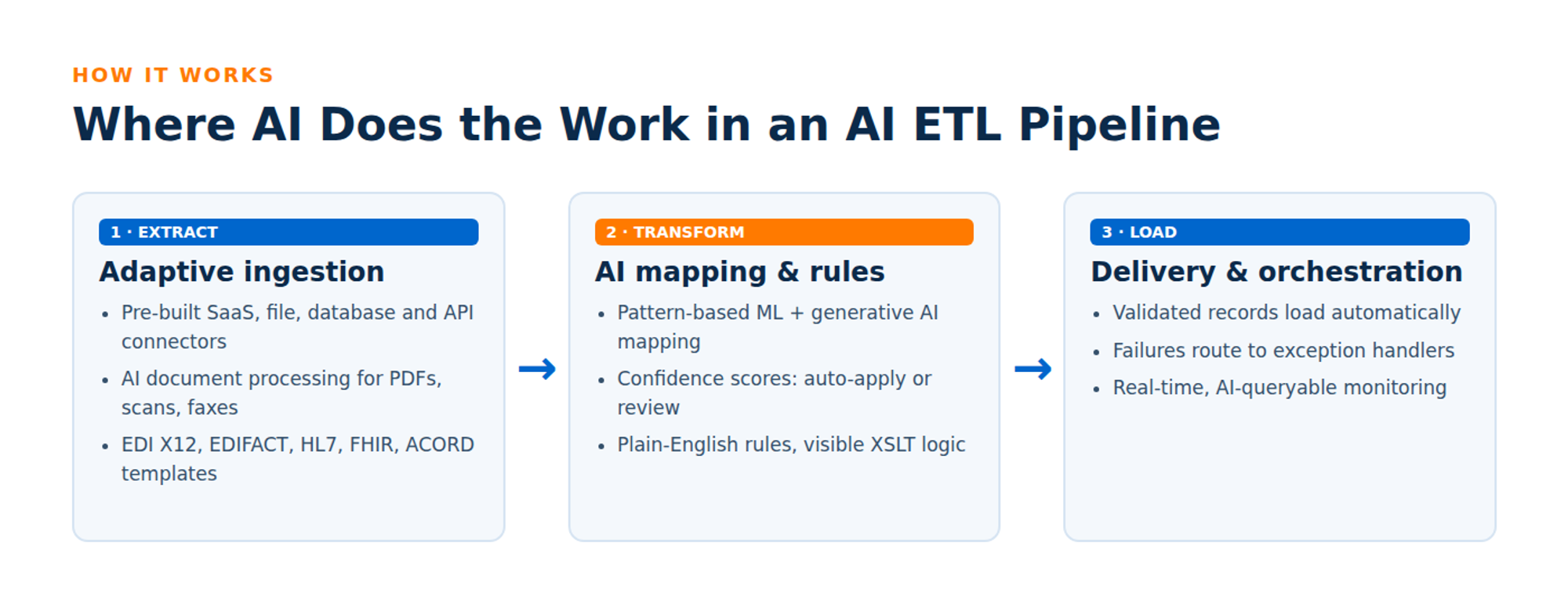
An AI ETL pipeline still runs through the same three stages as traditional ETL, but AI does substantive work at each one, from ingestion through the final data load.
Extract: Adaptive Ingestion Across Files, APIs, and EDI
Extraction in an AI ETL pipeline covers more ground than structured databases and clean APIs. Pre-built connectors handle hundreds of SaaS, file, database, and messaging sources, with credentials managed centrally rather than hard-coded per pipeline. Where traditional ETL treats documents as something outside the pipeline, AI ETL extends extraction to unstructured and semi-structured sources directly: intelligent document processing uses generative AI to extract structured data out of PDFs, scanned forms, and faxes, so a document becomes a first-class data source rather than a manual workaround. The same extraction layer handles industry EDI and healthcare formats (X12 transaction sets, HL7, FHIR, ACORD) through pre-built templates instead of custom parsers built from scratch for every partner.
Transform: AI Data Mapping and Machine Learning Business Rules
Transform is where AI ETL changes the work most. Schema mapping, matching each source field to its corresponding target field and writing the logic to reshape it, has historically been the most labor-intensive step in any ETL pipeline. AI-powered data mapping typically runs two complementary engines. A pattern-based machine learning engine compares a new source and target schema against a library of previously validated mappings and proposes matches based on patterns it has already confirmed; this engine is fast, explainable, and improves automatically as more validated mappings get added to the library. For mappings the pattern engine can't resolve (an unfamiliar schema, an ambiguous field name), a generative AI engine reasons over field names, sample data, and any business context a user provides in plain language, such as describing how lead data should be filtered and deduplicated before it lands in a target system.
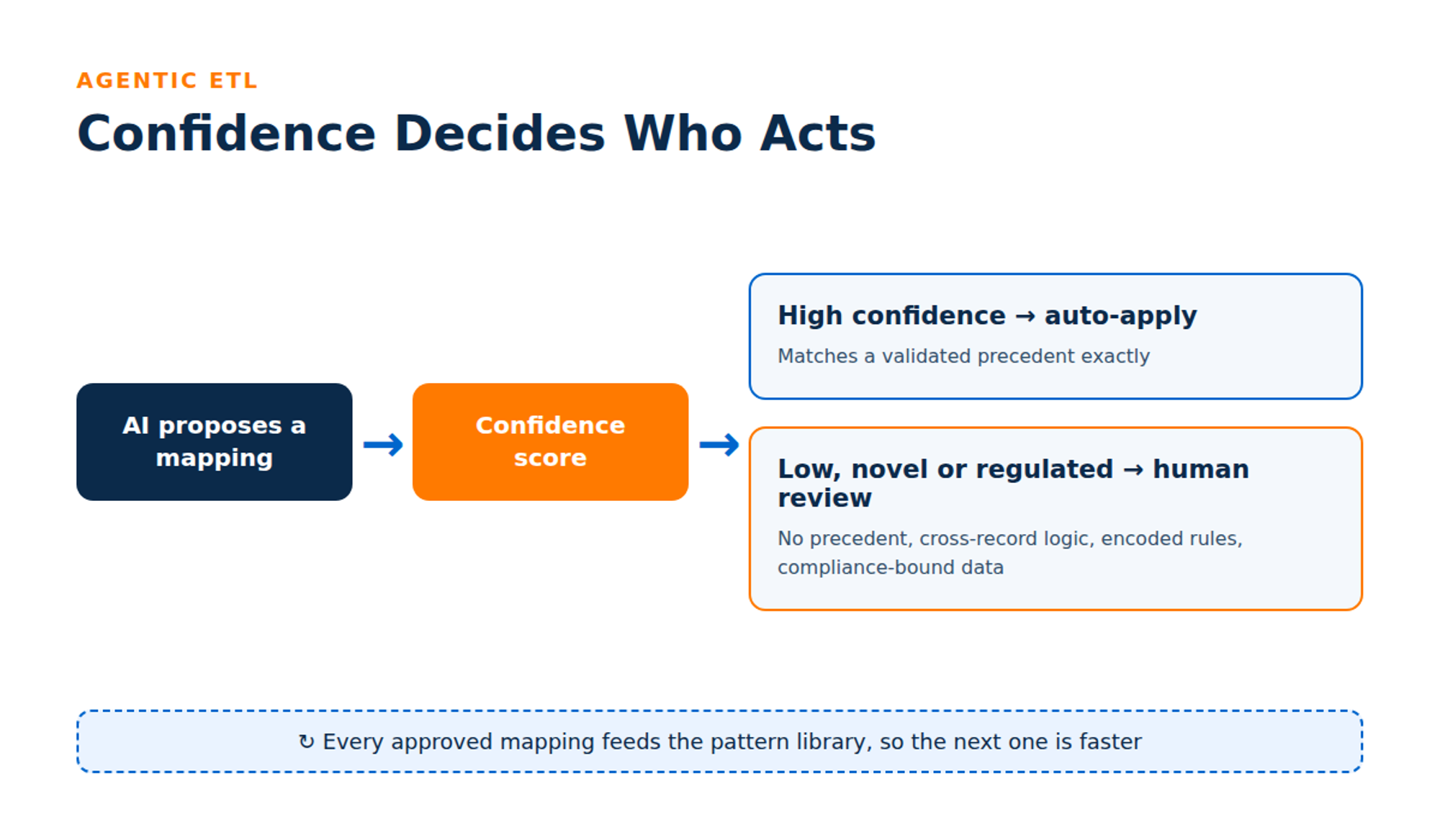
Each proposed mapping in this kind of AI ETL pipeline carries a confidence score. High-confidence, "confirmed" matches, where a field name or schema pattern lines up exactly with a validated precedent, apply automatically. Lower-confidence, "suggested" matches route to a person for review, and once approved, feed back into the pattern library so the next similar mapping benefits. The transformation logic AI generates for each match stays visible and editable, typically as XSLT, so a data engineer can inspect exactly what the pipeline will execute rather than treating the AI's output as a black box. (For a closer look at this workflow, read Smarter Data Mapping with Adeptia Automate's AI-Powered Copilot.)
Business rules and data quality checks follow the same pattern. Instead of a developer writing SQL case statements or custom validation code, a business user describes a rule in plain English, for example, flagging any claim that exceeds a policy limit for review, and the system compiles that description into executable validation logic, testable against sample data before it goes live. Changes to the rule don't require a code deployment.
Load: Intelligent Delivery and Workflow Orchestration
The load stage in AI ETL still delivers transformed data through the appropriate data flows into its target (a warehouse, an application, a trading partner's system), but AI ETL extends load into orchestration and exception handling. Records that pass validation load automatically; records that fail route through configurable exception handlers instead of failing silently or halting the pipeline. Real-time monitoring surfaces load failures with execution-level detail as they happen, rather than requiring someone to notice a downstream report is wrong. Some AI ETL tools also expose this operational data, pipeline status, failure trends, exception counts, through an interface an AI assistant can query directly, so an operations lead can ask a natural-language question about overnight load failures instead of navigating a dashboard by hand. Adeptia Automate 5.2 is one example of this AI-accessible observability.
Schema Drift Detection and Self-Healing Pipelines
Because AI ETL mapping is a live capability rather than a one-time hand-coded step, it can respond to schema drift instead of silently breaking on it. When a source adds a field, renames one, or changes a data type, an AI ETL pipeline can detect the mismatch, propose an updated mapping using the same pattern-matching and generative reasoning it used originally, and route the change for quick human confirmation rather than requiring an engineer to diagnose and rewrite it. This is what people mean by a self-healing pipeline: not that it silently changes what it does without oversight, but that AI absorbs the diagnostic and first-draft work while a human still approves the fix before it goes live.
Related Webinar
Intelligent ETL: AI-Native Automation for AI-Ready Data
See why traditional ETL struggles with messy enterprise data, and how AI-native automation gets that data ready for AI.
Agentic ETL: When Pipelines Start Making Decisions
Agentic ETL is the next layer past AI-assisted mapping and rules: AI agents that don't just propose a mapping but take multi-step action across the pipeline, detecting a schema change, drafting the updated mapping, testing it against sample data, and routing only the genuinely uncertain cases for human sign-off, without a person walking through each step manually. Agentic ETL pipelines can be exposed to an organization's own AI assistants through open interfaces such as the Model Context Protocol, so an AI agent, not just a person at a dashboard, can query pipeline status, inspect a failed load, or trigger a workflow directly, under the same role-based access controls that govern human users.
The appeal is clear: it removes the person from routine, well-understood decisions and reserves human attention for genuinely ambiguous cases. A new trading partner whose data format closely resembles fifty prior partners doesn't need a person walking through every field; an agent can handle the onboarding and escalate only the fields where confidence is genuinely low.
Where Human-in-the-Loop Review Still Belongs
Agentic ETL doesn't mean unsupervised ETL. A few categories of work still belong with a human reviewer: mappings with no precedent and no business context, where the AI is essentially guessing from field-name similarity; cross-record logic (deduplication, aggregation, multi-record reconciliation) that requires judgment a single confidence score can't capture; heavily encoded business rules, where a field value maps to a meaning only a domain expert would recognize; and any transformation feeding a regulated or high-stakes process, where a human-approval trail is itself part of the compliance requirement. A well-designed agentic ETL pipeline routes these categories to a person by default rather than leaving the boundary implicit.
Benefits of AI ETL for Enterprise Data Teams
The advantages of AI ETL show up most clearly at scale, where the same kind of integration work repeats across dozens or hundreds of sources and partners.
- Faster onboarding. Partner and data source onboarding that took four to eight weeks under traditional ETL commonly compresses to days under AI ETL, because AI proposes the data mapping and validation logic instead of an engineer building it from scratch each time.
- Lower developer dependency. Business users can review and approve AI-proposed data mappings and plain-English business rules directly, freeing engineering to focus on architecture and the genuinely hard data cases AI can't resolve alone.
- Better handling of unstructured data. Intelligent document processing brings PDFs, scans, and forms into the same data pipeline as structured data instead of routing that data around the pipeline manually.
- Faster response to schema drift. AI ETL pipelines can detect a schema change and propose an updated mapping in minutes rather than waiting for an engineer to notice and fix it.
- Compounding accuracy. Every mapping a person confirms strengthens the pattern library, so accuracy improves with use rather than staying static.
- Transparent, editable logic. AI-generated mappings and rules are visible as actual transformation code, not a black box, so engineers can inspect and adjust them rather than trusting them blindly.
- Operational visibility. Real-time monitoring, and in more advanced platforms AI-queryable operational data, surface pipeline failures immediately instead of after a downstream report goes wrong.
Risks, Governance, and Compliance Considerations
AI ETL raises real governance questions, and an honest evaluation of any AI ETL platform has to address them directly rather than assuming AI-generated data mappings carry the same risk profile as AI-generated marketing copy.
Traceability and Auditability
Every AI-proposed data mapping and rule needs to be traceable: why did the AI propose this data transformation, what precedent or reasoning produced it, and who approved it before it ran against production data. A defensible AI ETL platform preserves the full history, the proposed mapping, its confidence score, any human modification, and the approval, as part of the pipeline's audit trail, not as an ephemeral suggestion that disappears once accepted. For regulated data, this audit trail is often what actually satisfies a compliance review, more than the fact that a human wrote the original logic by hand.
Data Residency and On-Premises Requirements
Where the AI itself runs matters, particularly for regulated data. A cloud-hosted large language model, an isolated single-tenant deployment, and a fully on-premises model each carry different data residency and exposure implications. Enterprises evaluating AI ETL for regulated data (health records, financial transactions, personally identifiable information) need a clear answer to where the AI processing happens, what data leaves the environment during inference, and whether the platform can run entirely within an on-premises or private-cloud boundary if that's a hard requirement.
Where AI Should Not Run Unsupervised
Some transformation logic shouldn't run without a human in the loop, regardless of how confident the AI ETL engine is. Financial calculations that feed regulatory reporting, clinical data feeding a patient-safety workflow, and any mapping with no precedent and no supplied business context are reasonable candidates for mandatory human review, not just optional review. The right posture isn't "trust the AI everywhere except where it's obviously wrong." It's deciding in advance which categories of transformation require sign-off and configuring the AI ETL pipeline to enforce that boundary automatically, rather than leaving it to individual judgment in the moment.
AI ETL in Regulated Industries
Regulated industries adopt AI ETL for the same reason anyone does: less manual mapping work, faster onboarding. But they also need governance and traceability baked into the pipeline from day one, not added afterward. See how this applies across Adeptia's industry solutions, including healthcare data integration.
Financial Services and Insurance
Financial services and insurance data integration involves high partner volume and strict regulatory obligation together. An insurance carrier receiving enrollment data from dozens of benefit administration platforms, each encoding a standard transaction set slightly differently, is a textbook AI ETL use case: AI proposes the platform-specific mapping variations against a canonical model, a person reviews the result, and onboarding a new platform drops from weeks to days instead of requiring a bespoke project each time. A retirement plan recordkeeper ingesting payroll contribution data from a dozen payroll providers faces the same pattern: different field names and code conventions for the same concept, resolved through AI-proposed mapping rather than a custom build per provider. Because the data feeds regulatory reporting and individual account records, traceability and human approval of every mapping remain non-negotiable, even as AI does the first-pass work. Learn more about financial data integration with Adeptia.
Manufacturing and Distribution
Manufacturing and distribution organizations run high-volume, format-diverse supplier and order-to-cash integrations: EDI purchase orders, EDIFACT orders, custom CSV feeds, and API submissions arriving from hundreds of suppliers across regions and formats. AI ETL handles the unit-of-measure conversions, tax variations, and supplier-specific quirks that would otherwise require a custom mapping project per relationship, while a person reviews anything the pattern library hasn't seen before. This scale, hundreds of onboarding events a year, is where AI ETL's compounding pattern library produces the largest time savings relative to traditional ETL. For more, read B2B EDI integration best practices for faster partner onboarding.
What to Look for in an AI ETL Platform for Data Integration
Not every set of tools advertising AI features in its ETL pipeline is doing the same amount of work. A few distinctions separate AI ETL tools that genuinely automate mapping and rule work from tools using AI as a surface-level feature.
Look for mapping tools that combine pattern-based machine learning with generative AI reasoning, rather than pattern matching alone. Pattern matching handles familiar cases well but fails on anything genuinely novel, which is exactly where generative reasoning is needed. Look for confidence scoring that distinguishes high-certainty matches from ones that need review, so the pipeline can auto-apply what it's sure about and route the rest to a person. Look for plain-English business rule tools that compile descriptions to real, testable logic rather than requiring SQL or a proprietary scripting language for every validation rule. Look for intelligent document processing tools that treat PDFs and scanned documents as first-class pipeline inputs, not a manual detour. Look for full transparency into the generated transformation logic, visible, editable code, not a black box, so engineers can verify and adjust AI output using the same tools they already trust. And look for real-time, AI-accessible operational monitoring tools, so pipeline health and failures are visible immediately rather than discovered downstream. You can review these capabilities on Adeptia's AI features page.
Evaluation Checklist
- Does the platform combine pattern-based ML and generative AI for schema mapping, or rely on one alone?
- Are proposed mappings scored by confidence, with a clear threshold for auto-apply versus human review?
- Can business users author validation rules in plain language, tested against sample data before deployment?
- Does the platform extract structured data from unstructured documents (PDFs, scans, faxes) into the same pipeline as structured data?
- Is the AI-generated transformation logic visible and editable, or opaque?
- Does the platform preserve a full audit trail of every AI-proposed mapping, human modification, and approval?
- Where does the AI processing run (cloud-hosted, isolated tenant, or on-premises), and does that meet your data residency requirements?
- Does the platform expose pre-built templates for the industry-standard transaction sets (EDI X12, EDIFACT, HL7, FHIR, ACORD) relevant to your data?
- Can operational data be queried by an AI assistant, and does that access respect the same role-based permissions as a human user?
- How does the vendor's AI mapping perform on your actual schemas, not the demo dataset, including at least one genuinely unusual case?
Put Adeptia through this checklist
See pattern-based ML and generative AI mapping, confidence scoring, and full audit trails working on real schemas.
How to Get Started with AI ETL
The most reliable way to evaluate AI ETL tools is against your own data, not a vendor's demo dataset. Bring two real schemas from an integration you actually need to build: one simple, common case, and one with the kind of proprietary encoding or unusual structure that tends to break naive pattern matching. Watch how the platform handles both, not just whether it proposes a mapping, but whether it explains its reasoning, how it handles the fields it can't confidently resolve, and whether the proposed transformation logic is something an engineer can inspect and adjust.
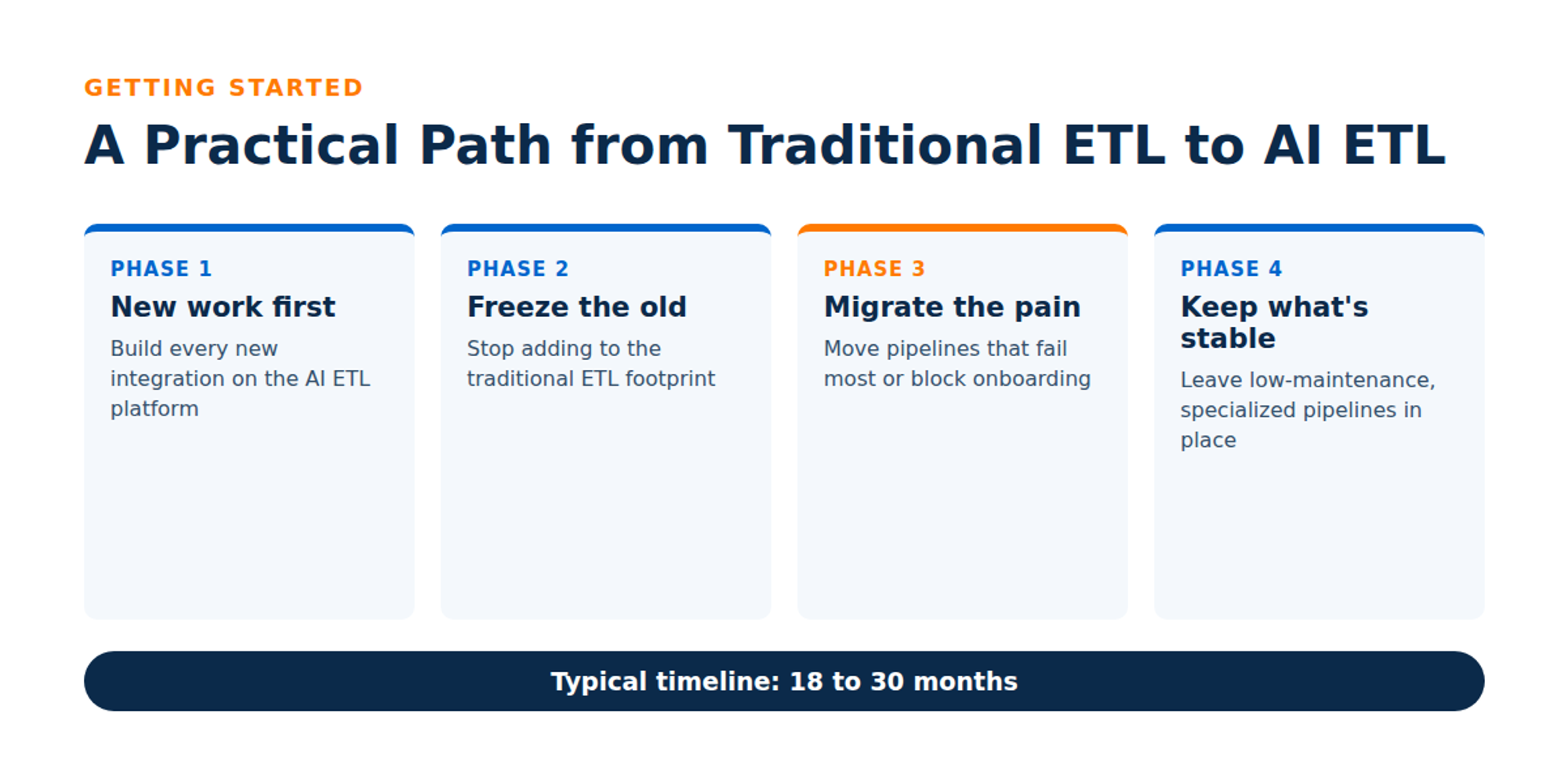
Most enterprises don't replace their entire traditional ETL footprint at once. A practical migration path sends new integrations to the AI ETL platform first, stops adding to the traditional ETL footprint, and prioritizes migrating the highest-pain existing pipelines: the ones that consume the most engineering time, fail most often, or block partner onboarding. Stable, low-maintenance pipelines that have run unchanged for years are often not worth migrating; the return on that work is low. This pattern typically retires the majority of a traditional ETL footprint over 18 to 30 months, with what remains being either too stable to be worth moving or specialized enough that a custom, engineer-built pipeline is still the right tool.
Bring Your Own Schemas to the Test
The fastest way to know if an AI ETL platform can handle your data is to stop watching a demo and start feeding it your own schemas. Talk to the Adeptia team about a working session where you bring a real integration, common or messy, and see how the mapping, the rules, and the audit trail hold up.
Book a Working Session →