Every October, the same thing happens. Enrollment volume spikes, plan changes pile up, and eligibility files start moving faster than most systems were built to handle. For a few weeks, your data infrastructure gets tested harder than at any other point in the year, and there's no partial credit for getting it mostly right.
If you work in data or IT at a carrier, TPA, or health plan, you already know this. AEP isn't really about enrollment. It's about whether your health insurance data mapping can keep up with it.
The pattern repeats every year
Eligibility files (EDI 834s) arrive in every shape imaginable, because every employer group and every partner system does things slightly differently. Multiply that by dozens of groups, compress it into a six-to-eight-week window, and layer on hard SLA deadlines, and you get the same recurring problem: mapping becomes the bottleneck.
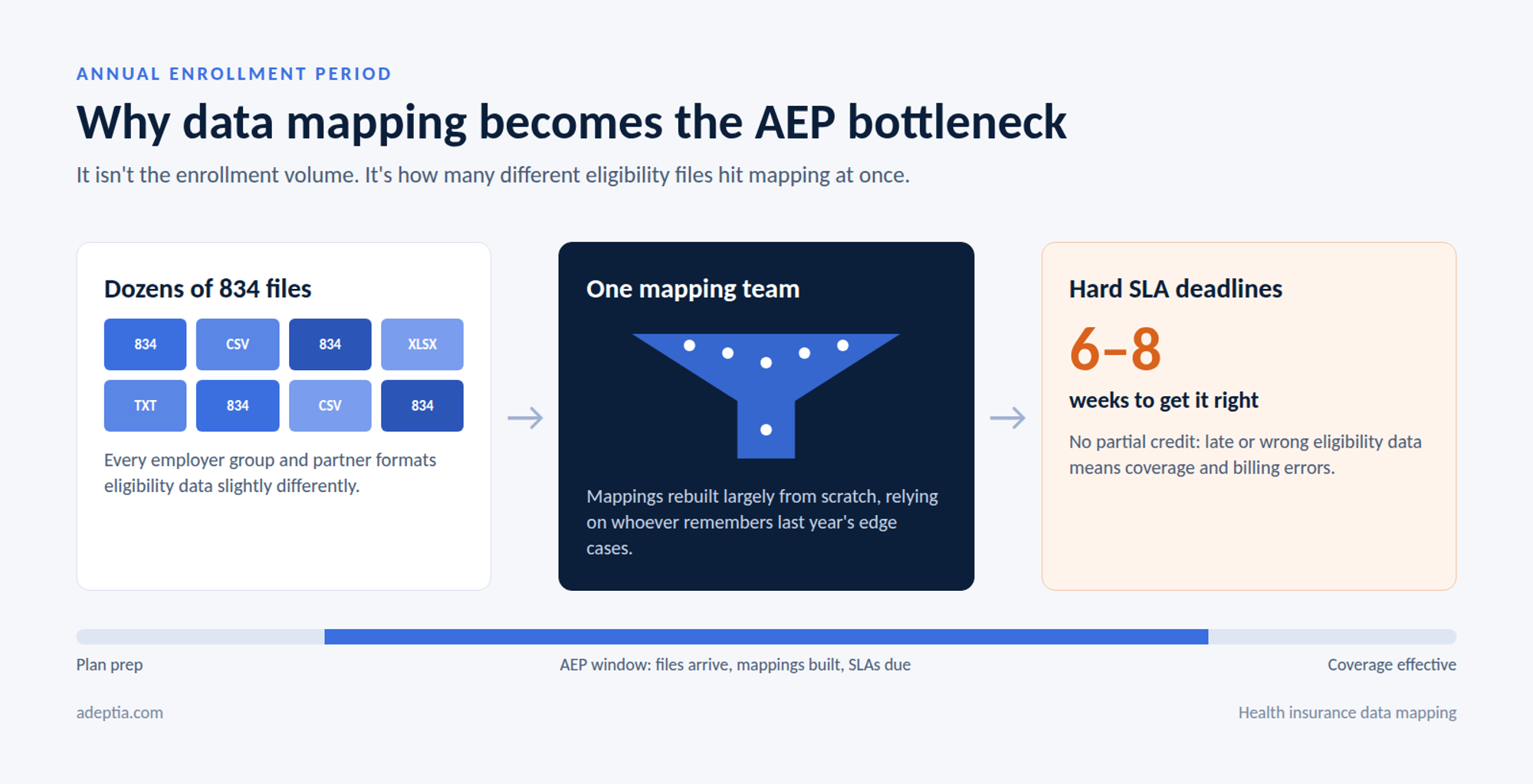
Not because anyone did anything wrong. It's because most mapping work is built the same way most years: largely from scratch, by whoever remembers how last year's edge cases were handled. When that person is out, or the partner's file format shifts slightly, or a new group gets added late, the team ends up doing under pressure what should have already been solved.
That's the real stress test. Not enrollment volume itself, but whether your data team is relearning the same lessons every single AEP.
What actually breaks
A few patterns show up almost every year, regardless of company size:
- Format drift. A partner or vendor changes a field, a delimiter, or a code set, often without much warning, and the mapping quietly starts producing errors instead of failing loudly.
- Tribal knowledge gaps. The mapping logic for a tricky group or an unusual plan design lives in one person's head, not in a system anyone else can maintain.
- Manual firefighting. When something breaks mid-crunch, the fix is a rushed patch rather than a permanent one, which means the same issue often resurfaces next year.
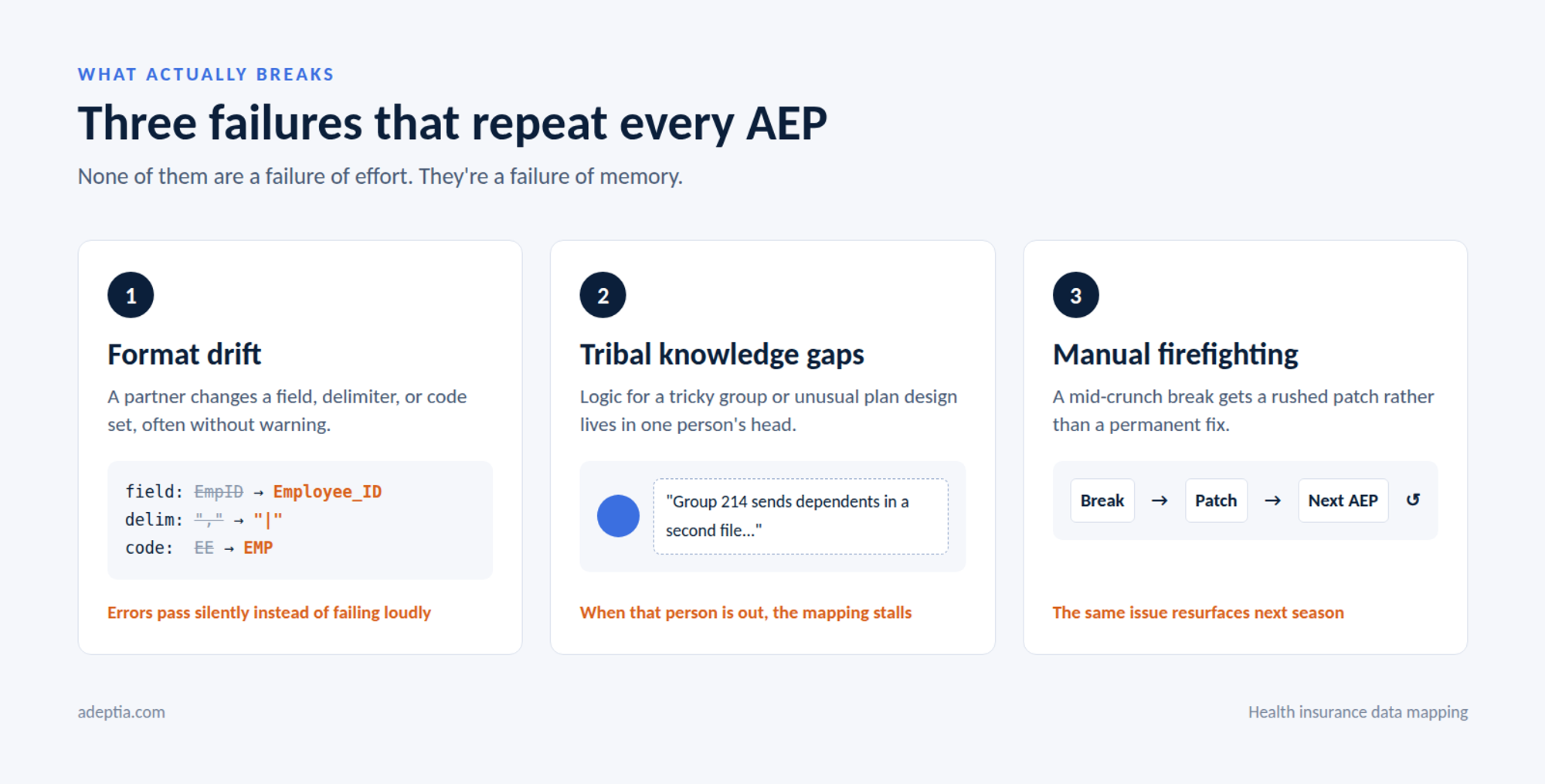
None of this is a failure of effort. It's a failure of memory. Most mapping systems don't retain what they learned last AEP, so every season starts closer to zero than it should. (The same gaps surface during plan changes too; see 5 data problems that derail carrier transitions.)
Why this doesn't have to be the norm
This is the exact problem we built Adeptia's AI Mapping Agent to solve. It isn't a blank slate that has to relearn your business every crunch season. It comes in already understanding how core systems and standard formats like FHIR map to real-world data, and it gets sharper with every mapping your team builds. The tenth mapping is easier than the first, and next AEP starts from what it learned this AEP, not from scratch.
When mappings run, they run as code: deterministic, auditable, and consistent under the exact kind of load that AEP creates. That's a meaningfully different experience from a system that "mostly works" until volume spikes. Learn more about how Adeptia Automate runs these mappings in production.
We've seen what this looks like in practice: one of our carrier clients, Voya, cut onboarding time for new data sources from four to five weeks down to three to four hours. That's not a hypothetical efficiency gain. It's the difference between a team that's still building mappings when enrollment opens and one that already has it handled.
See the AI Mapping Agent on a real 834 file
Bring one of your messiest eligibility files. We'll show you how it gets mapped, validated, and reused next season.
Where this leaves you right now
If your team is in the middle of AEP as you're reading this, this post isn't a pitch. It's a nod to something you already know: the pressure is real, and it's not a reflection of how well your team is doing. It's a reflection of how mapping work has traditionally been built.
We put together a short AEP Data Readiness Checklist that walks through the most common gaps we see teams hit each season. It's worth a look if you want a quick gut-check on where next year's AEP is likely to bite. No pressure, just something useful for the season you're actually in right now.
Get ahead of next AEP
Check your gaps now, or talk to our team about automating eligibility file mapping before the next crunch.